

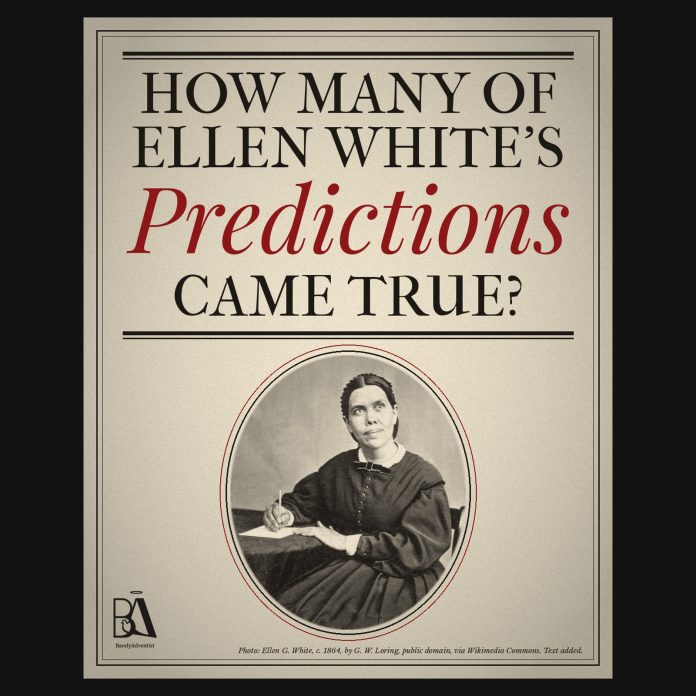
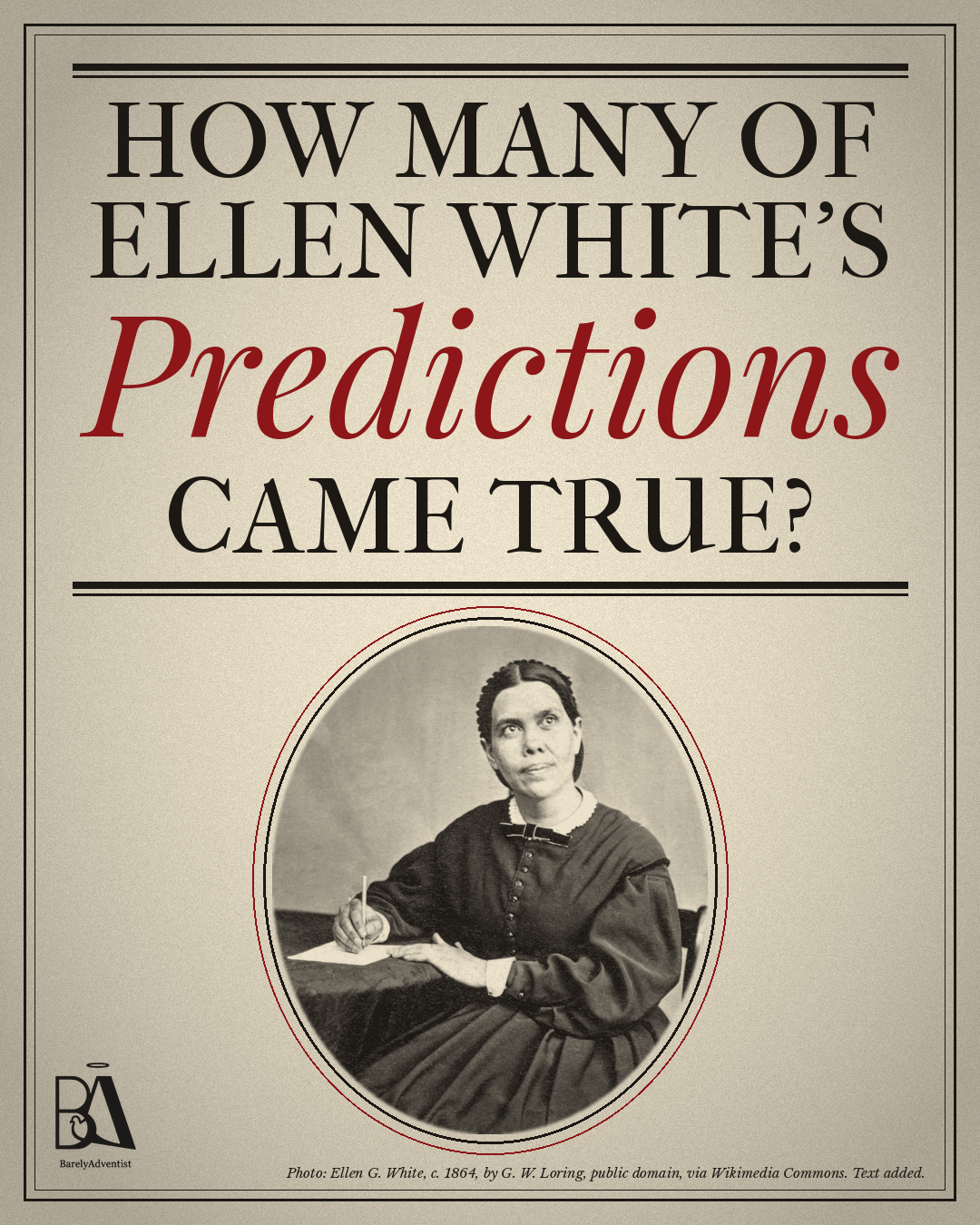
Ask ten Adventists how many of Ellen White’s predictions came true and you will get ten different answers, so it is worth checking the record itself.
Tobacco first. In 1864 she called it “a poison of the most deceitful and malignant kind” whose effects were “so slow, and at first scarcely perceivable.” The major studies tying smoking to lung cancer came out in 1950. Her warning was about nerves and the brain rather than cancer, but the core claim held up.
The Civil War. In January 1861, three months before Fort Sumter, she had a vision at Parkville, Michigan. An eyewitness, J. N. Loughborough, later recalled her saying more states would secede and a terrible war would follow. That account is his memory, not her own pen. In 1862 she wrote that “when England does declare war” there would be “general war.” England never did. Critics call that a miss. Defenders note her sentences just before were conditional (“if England thinks it will pay”).
San Francisco. In 1902 she wrote that “not long hence these cities will suffer under the judgments of God.” The earthquake came in 1906. She herself rejected reports that she had predicted it: “This is not true.” The White Estate biography agrees she warned of judgments rather than foretelling the quake.
Battle Creek. On 30 December 1902 the Review and Herald plant burned. Three days later she wrote of months of foreboding and said she had seen “a flaming sword of fire stretched over Battle Creek.” Supporters see a warning fulfilled. Skeptics point out the description was written after the fire.
The 1856 conference. She reported an angel saying of those present: “Some food for worms, some subjects of the seven last plagues, some will be alive and remain upon the earth to be translated at the coming of Jesus.” All of them have died. The White Estate calls it unfulfilled and explains it with her 1883 statement that “the promises and the threatenings of God are alike conditional.”
Still future. She wrote that American Protestants would “clasp hands with the Roman power” and that legislators “will yield to the popular demand for a law enforcing Sunday observance.” In 1888 Senator Henry Blair’s national Sunday bill seemed to fit, but it never passed, and no national Sunday law has passed since. Adventists who accept her expect it ahead. Others see a fear rooted in the 1880s.
Put together, the record includes health counsel that aged well, warnings that matched events in general terms, statements later read as conditional, and predictions still waiting. Each reader can weigh them, but the record deserves to be read in full.
Photo: Ellen G. White, c. 1864, by G. W. Loring (New York Gallery, Battle Creek), public domain, via Wikimedia Commons: https://commons.wikimedia.org/wiki/File:Ellen_G._White.jpg (text added)
Head over to Adventist Today for current events, analysis, and opinion on all things Adventist.


