

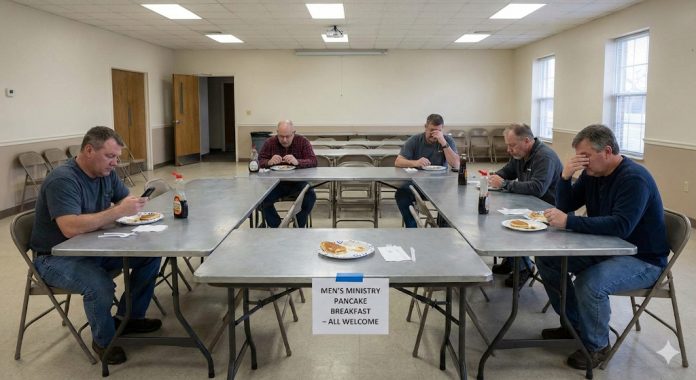
When you ask why men’s ministries struggle in Adventism, you don’t get one clear answer. You get a swirl of awkward explanations — people say men don’t show up, that the groups turn into conservative echo chambers, that they become stereotype-driven (veggie meat, tools, bravado), that men should just join regular church programs, or everyone has a story about the last men’s ministry that went weird. Some of those concerns are valid. Some are excuses. But none of them address the deeper problem we keep ignoring.
The truth we overlook
Most Adventist churches are not overflowing with men. Go to almost any congregation and you’ll see more women, more involvement from women, and more volunteer labor falling on women’s shoulders. Yet we keep telling ourselves the church “skews male” because most of the visible leadership is male.
That illusion has kept us from noticing something painful: men are showing up less, speaking up less, and opening up least of all.
Men are hurting, and we don’t talk about it
Men in Adventism struggle with vulnerability. The unspoken rule is simple: be strong, be fine, don’t need help. The result is quiet suffering — men managing depression on their own, wrestling with addiction in silence, carrying family and financial pressure with no support, and young men wondering who they’re supposed to become because mentors are scarce. Husbands feel shame admitting they’re overwhelmed. If you think men don’t need a space to talk, you’re not watching what’s happening.
Yes, men’s ministries have gone bad before
Many hesitate because they’ve seen men’s ministry done poorly: groups that excused bad behavior, leaders who used the platform to assert ego-driven authority, or events that felt like gender politics instead of genuine formation. Those failures are real — and they deserve to die. But they’re not an argument against men’s ministry. They’re an argument for doing it better, maybe for the first time.
What men’s ministry could be
Imagine a space where Adventist men finally feel safe enough to say, “I’m not okay.” A place where vulnerability isn’t embarrassing, where men learn emotional language beyond “fine,” where older and younger men actually support one another instead of pretending everything is under control. Imagine friendships that go deeper than sports talk, prayers that feel honest instead of performative, and accountability that lifts men up rather than shaming them. Imagine pastors who aren’t carrying the emotional load alone, families strengthened because men have community, and boys growing up watching healthy, humble, emotionally present men model faith.
This is one of the biggest gaps in Adventism
We’ve built strong women’s ministries and structured youth programs. We have Pathfinders, Adventurers, singles groups, and health initiatives. For men, though, it’s often a quarterly breakfast or an occasional retreat — maybe a devotional book printed in 1997. Meanwhile loneliness, mental-health struggles, and disengagement among men are rising. Acting like this will fix itself is no longer an option.
A hopeful challenge
Local churches: take men’s ministry seriously. Not as a side project or nostalgia trip, and not as a stereotype. Build a space where men can be honest, supported, challenged, and spiritually grounded. Men need community just as much as anyone — maybe more right now. Healthy men help build healthy churches. The Adventist Church can’t afford to ignore this any longer.
—————

