

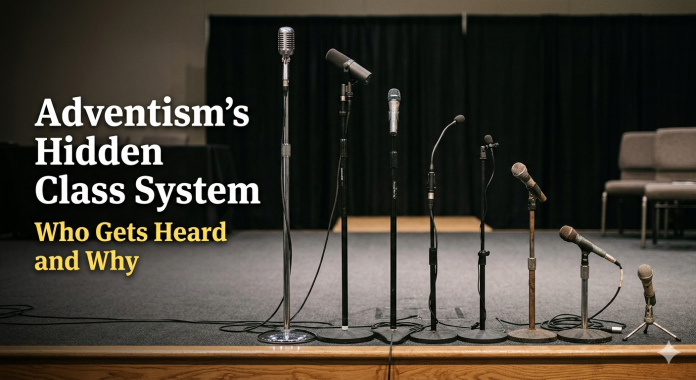
Every church says it listens to everyone. But every church develops a quiet hierarchy of who actually gets heard.
Adventism is no exception.
There’s no formal system. No written ranking of voices. But over time, one forms anyway—through habit, culture, and repetition.
It shows up in who gets invited into decision-making spaces, and who gets thanked after decisions are already made. It shows up in which concerns are treated as “strategic insight,” and which are dismissed as “local feedback.”
The system rewards fluency. If you can speak committee language, reference structure, and move comfortably through institutional processes, you are treated as credible. If you speak from a struggling local church, a minority context, or outside the system altogether, your voice often arrives pre-filtered—translated into something safer, less urgent.
Even geography plays a role. So does education. So does proximity to leadership centres. Over time, credibility clusters in familiar places, and unfamiliar voices start sounding less like insight and more like noise.
The danger isn’t intentional exclusion. It’s insulation. And insulation always changes what you can hear.
The irony is that Adventism has strong theology for the margins. The “least of these” is not decorative language. It is central. But institutions don’t automatically live their theology. They drift toward what feels efficient, legible, and manageable.
This isn’t fixed. It’s cultural, not doctrinal.
A more honest church wouldn’t reject expertise—but it would widen credibility. It would treat proximity to people as a form of intelligence.
Because the real question isn’t whether the church is listening.
It’s who it has already decided is worth hearing.
❤️
Support BarelyAdventist
BarelyAdventist exists in the space the church keeps struggling to name: where people still love Adventism but are no longer willing to ignore its blind spots. It speaks into questions of power, voice, culture, and credibility with clarity and restraint—without cynicism and without performance—so that what’s actually happening in the system can be seen clearly enough to be healed rather than denied.
If Adventism is going to grow in trust, generosity, and global maturity, it won’t come from louder branding or tighter control, but from widening who gets heard and telling the truth about what people are already experiencing. Supporting BarelyAdventist means sustaining that clarity: content that doesn’t flatten tension, doesn’t avoid difficulty, and doesn’t abandon hope—but insists the church can only become stronger by becoming more honest.
❤️ Love BarelyAdventist? Support us on Patreon for as little as $1 per month

